/

2026 October

October 2026

Welcome to the latest issue of the Buffini Newsletter. This month’s issue is all about leading with intention: being intentional about how you leverage your time, the conversations you have, and the way you lead others. I know the coach’s tip, member spotlight, and everything else in this issue will help set you up for an intentional month of success.

Make sure you subscribe so you never miss a future issue.

Enjoy!

Derek Jones,
Director of Community

The three conversations that change everything

By Sherri Starr McCusker, Business Coach

One of the greatest privileges of being a Buffini Coach is having a front-row seat to the breakthroughs that completely change the trajectory of an agent’s business.

What’s fascinating is that those breakthroughs rarely come from a shiny new marketing strategy, the latest social media trend, or even the perfect listing presentation (yes, even the really pretty ones).

Instead, they come as a result of having the right kind of conversation.

What conversation isn’t happening that needs to?

Every week, I hear questions like:

  • “Why aren’t my clients giving me referrals?”
  • “Why are my buyers unmotivated to take action?”
  • “How can I help my sellers be more realistic about the market?”
  • “How do I ensure a potential client chooses me over the other agents they’re interviewing?”

When Carla Harris, a top Wall Street executive and leadership expert, blessed our stages in 2025 at both the Peak Experience® and Leadership Conference™, she talked about the importance of having what she calls “adult conversations.” That phrase has stuck with me.

After thousands of coaching conversations, I’ve come to believe she’s right.

Here are the three conversations I believe every real estate professional needs to master.

1. The conversation that creates understanding

When something isn’t moving forward, our instinct is often to explain more, educate more, or convince harder.

Try curiosity instead. Ask more questions and listen intently. Seek to understand what’s underneath the objection instead of trying to overcome it.

A seller who won’t consider reducing their price may not be resisting the market but rather grieving what they thought their home was worth.

A buyer who won’t make a decision may not be indecisive, but may simply be afraid of making the wrong one.

The next time you’re tempted to ask, “How do I get them to…” try asking yourself, “What do I still need to understand?”

2. The conversation you’ve been avoiding

Every agent has that one conversation they tend to avoid. It could be about a price reduction. It may be hesitancy to ask for referrals or to check in on past clients. Or maybe it’s about setting healthy boundaries with a client who’s consuming more time than they should.

Often, those conversations become a much bigger issue in our minds than they are in reality. Try taking that first step and see what happens. You may be surprised at the results.

For example, for 11 years, one of my clients avoided directly asking her database for referrals.

She was exceptional at building relationships, consistently wowed her clients and delivered incredible service. But when it came time to simply ask for the referral, she just couldn’t bring herself to do it.

During one of our coaching sessions, she finally committed to trying. We roleplayed the dialogues to prepare.

The next time we met, she was practically beaming.

“Well… it only took me 11 years to finally ask for referrals. And who would’ve thought? They actually work! I got four new referrals last week just from asking!” she said.

Boom. Nothing else had changed. She simply had a conversation she’d been avoiding for over a decade.

If you’re feeling stuck, ask yourself, “What’s the conversation I’ve been avoiding?”

Then have it.

PRO TIP: When it comes to difficult conversations, I like to ask for permission first. Try something like, “Is it alright if I share the truth as I see it?” Asking for permission lowers defenses, builds trust, and prepares people to truly hear what you’re about to say.

3. The conversation that leads to confidence

People hire a real estate professional because they want someone who will help them navigate uncertainty, simplify difficult decisions, and confidently guide them through one of the biggest financial and emotional decisions of their lives.

That requires knowledge and confidence.

One of my favorite reminders is, “Their confidence in you is derived from your confidence in yourself.”

It means being willing to say, “Based on everything you’ve shared with me, here’s what I recommend.”

Or, “If you were my family, this is the advice I’d give you.”

Remember, they didn’t hire you to simply unlock doors or write contracts.

They hired you because they wanted a professional they could trust.

Why working by referral works

Working by referral continues to be the best way to build a thriving real estate business because it’s focused on relationships, not just transactions. And relationships are built one conversation at a time, creating trust, deepening relationships, and helping people move forward.

Have those conversations and watch how your business starts to change. Sign up for a free business consultation to get started on the process. You’ll get clear on your vision, discover what’s holding you back, see what’s working well for people just like you, and get action steps to move forward. Schedule your business consultation today.

Three questions real estate leaders are asking

By Ethan Beute, Buffini Chief Ambassador

The problems sound different every time. Not enough hours in the week. Not enough right-fit agents. Not enough profit.

After hundreds of conversations with team leaders, broker/owners, and operations leaders, I can tell you the surface problems vary, but the questions underneath are often the same.

And they resolve in the same place: the productivity of your agents.

1. “What’s my job now? And should I still be selling?”

If you’re like most leaders, you built your business by being the best agent in it. Now your success runs through other people, and no one handed you a playbook for that. The production question makes it harder. Stay in production and you fund the business but starve its leadership. Leave production too soon and you starve the business. There’s no universal answer, but there is a universal test: does your involvement make your agents more productive, or does it make you the bottleneck?

Try this. Track one week of your time against a single filter: “Only I can do this.” Everything that fails the test gets documented and delegated. And before you leave production, know one number: what your team must produce for your leadership to pay for itself.

2. “How do I attract and retain right-fit agents?”

You can’t out-recruit weak retention. Agents rarely leave over splits. They leave when they stop growing and stop belonging. The leaders with the best retention put agent productivity first. The value proposition is some form of “You’ll do more business here than anywhere else.” Recruiting gets easier when that’s true and you can prove it. Productive agents are your proof and your recruiters.

Try this. Before your next recruiting push, calculate per-agent production for your current roster. If it’s not a number you’d publish, fix that first. Recruiting and retention both run through agent success.

3. “Why is my top line growing but my take-home isn’t?”

Most leaders know their volume cold. Fewer know their net margin at all. Agent count is a vanity metric. Agent productivity is the profit metric. Ten agents averaging two closings a quarter can out-earn two dozen agents averaging one (with less overhead, less churn, and less chaos).

Try this. Learn two numbers this month: net margin and average production per agent. Then aim your training, mentoring, and accountability at raising the second number. And watch what happens to the first.

A new conversation for agent-first leaders

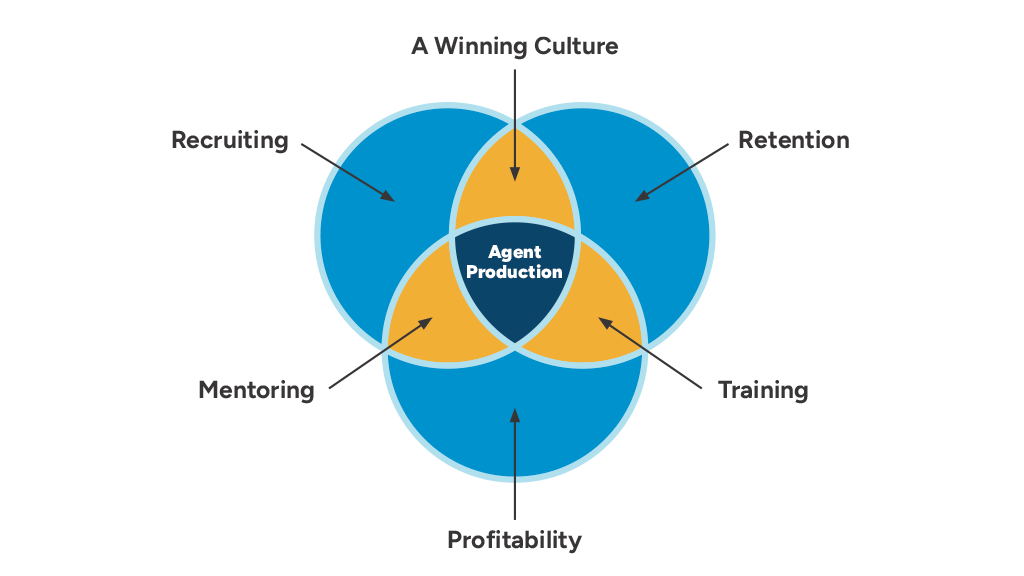
Three questions. One thread: leaders win when their agents win. That’s the premise of our leadership model. Recruiting, retention, and profitability become easier and more likely with higher agent productivity, which is driven by culture, training, and mentoring.

Agent Production

As a longtime podcast creator, I’ve hosted and produced 501 podcast episodes, including 182 specifically for real estate leaders and operators, learning directly from the people building the best teams and brokerages in the industry. Together with the Buffini Team, I’ve taken what I’ve learned from those leaders and helped create a new show.

On Wednesday, Nov. 11, I’m launching a new show with Buffini: The Agent-First CEO™.

Be the first to see and hear it. Learn from your peers. Sign up for updates at buffini.com/agentfirst.

Buy back your hours: a simple road map for hiring your first virtual assistant

By Geraldine Kriegbaum, Buffini Member

In this blog, Geraldine Kriegbaum shares her road map for hiring a virtual assistant. She’ll share more during our Community Connection webinar Wednesday, October 28 at 10 a.m. PT.

For years I did everything myself including closing disclosures, listing flyers, and even “just checking in” texts. I told myself I couldn’t afford help. What I didn’t realize was how much not having help was costing me.

Here’s the math that changed my mind. Take your annual GCI and divide it by the hours you actually work. That’s your hourly value. Now think about how many hours a week go to tasks that have nothing to do with the most important things only you can do, such as negotiating, advising, and showing up in person when it matters.

For most agents that’s 10 to 15 hours a week, or 40 to 60 hours a month of dollar-productive time wasted.

A virtual assistant (VA) costs a fraction of that hourly value. And the 30 to 60 minutes it takes to train them on a task pays you back a hundred times over.

That said, a wrong hire doesn’t just cost wages, it also costs retraining time, missed deals, and confidence.

If you’re considering hiring a virtual assistant, start with these steps:

1. Be clear on your own job description. As an agent, you’re responsible for lead generation, lead follow-up, appointments, contracts, and negotiation. A qualified VA can handle the rest.

I run every task through one question: does this have to happen in person? If not, it can be hired out. Build a master list of everything you do in a day, group it logically, and you’ll never again think there isn’t enough work to hand off.

2. Hire for mindset, not just skills. Almost everyone interviews well when it comes to the technical part of the job.

What separates a good VA from a wrong hire is how they talk about failure. I ask candidates to walk me through a past mistake they made and what they learned and implemented from that error. Ownership language predicts success; victim language predicts drama.

I find a personality assessment up front (like REALStrengths®) is helpful when I’m hiring someone to counter my own blind spots.

3. Set the standard before day one. My philosophy is to hire a VA for 30 days at a time to see if the relationship is a good fit. At the 90-day mark, we decide together whether it makes sense to continue it.

Establishing S.M.A.R.T. goals (specific, measurable, achievable, relevant, and time-bound) is crucial when evaluating the fit. That keeps the conversation on task without it becoming emotional.

For example, “Schedule and post three branded pieces every Friday,” is a specific goal you can evaluate. “Help with marketing” is too vague and broad.

If you’ve been telling yourself you can’t afford help, do the math first. You may find you can’t afford not to.

Geraldine will share her full road map and why you should consider hiring a virtual assistant at our Community Connection webinar Wednesday, October 28 at 10 a.m. PT. Register here to join and learn more.

Lindsey Fowkes

Lindsey Fowkes is the CEO/Owner of RE/MAX Collective in Tampa, Florida. Fifteen years ago, her business looked nothing like it does today.

Chaos and burnout

“Before Buffini, my business and life were pure adrenaline and chaos,” Lindsey said. “I was hoping for something to change. I was chasing leads that weren’t going anywhere. I felt like I was in this grinding cycle rather than actually building a career. Paycheck to paycheck or commission to commission wasn’t just a phrase; it was a reality at the time.”

That grind came with a real cost. She was burnt out, staying at her office until 6:00 or 7:00 p.m. each night and often working weekends as well. Worse, she found herself not even enjoying her work. It was when she became pregnant with her second daughter that she knew something had to change.

The turning point

After talking to her broker, he suggested that she join a class he was mentoring, Buffini’s 100 Days to Greatness.

Although she was down to her “last couple hundred dollars in the bank,” Lindsey decided to take a leap of faith and go for it.

“So I put it on a credit card, and I hoped and prayed that this was going to work, but I really committed to it,” she said. “It was funny because when I found out I was pregnant, and then I took this program about 100 days later, she was here and I actually had 12 transactions in the pipeline.”

“I realized that I probably needed some help, so I started to create a team at that time. I applied these concepts [from the 100 Days to Greatness program] to how I treated my team members and how I served my customers,” she added. “And so my entire routine and my entire attitude towards real estate completely shifted.”

That moment taught her something that still guides her.

“If you work this system, don’t change it and be consistent, it will change your life. It will change your way of doing things, the way you look at your business, and the way you communicate with your clients.”

Lindsey was in Referral Maker PRO for a few years before joining One2One Coaching. After launching her own brokerage, she moved into Leadership Coaching. At each level, she found support and resources to help her grow her business.

“We started out with ten people, and because of the culture that we were building, we ended up attracting a lot of other single agents and a lot of other single teams,” she said. “Scale came before I was definitely ready, but it’s an exciting journey.”

The decision to move into Leadership Coaching helped her to focus on the bigger picture, she said, and on the team’s overall production, not just her own.

It also helped her, she added, share the lessons that she has learned throughout her 20-year career so other agents will also achieve their own success.

Mom as a role model

Lindsey’s daughters recently told her that all their friends want to be like her.

“It’s kind of exciting,” she says. “It makes me feel like I did my best. I was present for what was important and that they’ve learned from that example.”

“I hope my daughters take from my story of building this business that you can live a life of purpose and you can live a life of success,” she says. “I love that I can show them that you can be a mom and you can be a successful business owner all at the same time.”

Lindsey’s good life

“The good life means to me today that I can manage my business, that I can be present, that I can travel with my family, that I can see my daughter in college and I can still run a successful business all at the same time,” Lindsey says. “So the good life to me is that I came out on the other side feeling refreshed, excited, doing great things. And it’s really what we all try to strive for.”

Watch Lindsey's story here.

November 2026: Why trust is so important in business
September 2026: Creating opportunity
August 2026: The fundamentals always win